Monday, August 31, 2015

Thursday, July 3, 2014
The Trash (Part 2)
Maybe I can understand leaving biodegradables to blow and rot. I've seen enough dogs and cows and goats rooting around in the piles to know that perhaps coconuts and banana peels and the ends of vegetables can be sustenance for other needy creatures. And what is not eaten by those lower in the food chain, can then degrade and fertilize the soil. OK, I can go there.
But what about the newspapers, and the plastic bags, and the plastic bottles?
And what about all the sad, dead sandals laying tossed aside at the temples and the tourist attractions?
Perhaps instead of the little slogans painted onto the cans by the well-meaning tourist site managers, there needs to be an all-encompassing nationwide campaign, like the Keep America Beautiful effort from the 70s, and the Don't be a Litterbug campaign from the 60s.
Maybe some good old fashioned programming of school children is called for, turning the kids not into Hitler Youth but instead into Pick Up The Trash Nazis. Maybe one hour a month schools could forgo the math and science, and talk about ecology and pride and community service and how beautiful India could be. Maybe colleges could give special consideration for kids who participate in Pick Up The Trash community service programs.
But who am I to make these suggestions?
But what about the newspapers, and the plastic bags, and the plastic bottles?
And what about all the sad, dead sandals laying tossed aside at the temples and the tourist attractions?
Perhaps instead of the little slogans painted onto the cans by the well-meaning tourist site managers, there needs to be an all-encompassing nationwide campaign, like the Keep America Beautiful effort from the 70s, and the Don't be a Litterbug campaign from the 60s.
Maybe some good old fashioned programming of school children is called for, turning the kids not into Hitler Youth but instead into Pick Up The Trash Nazis. Maybe one hour a month schools could forgo the math and science, and talk about ecology and pride and community service and how beautiful India could be. Maybe colleges could give special consideration for kids who participate in Pick Up The Trash community service programs.
But who am I to make these suggestions?
The Trash (Part 1)
And always.. The trash… the garbage.
(Warning: Links are to youtube.)
Everywhere you look, unless you've turned off a public street into carefully contained environments - like the Westin or Sheraton or the large modern hospital campus where we dropped someone off - trash blows in whatever breeze there is and lays in piles against buildings, in the gutters along the roads, against anything that stops it blowing. And no one picks it up.
In front of nice stores, against the high outer walls of the huge villas. In empty lots with slum dandelions, in a group of houses at the edge of a rural village. In the streets around the IT office parks. Folks eat an ice cream or a bag of chips, and drop the container on the ground. Ticket stubs, receipts, plastic bottles -- on the ground. A large grassy field against the blue bay becomes unbearable to photograph because of the garbage all around. Sometimes there are large piles on corners -- clearly gathered by someone and piled up there for who knows what reason.
Visually it reminds me of the Keep America Beautiful crying Indian ad from the 1970s.
It's bad in the cities -- and it's worse in the villages and rural areas.
(This is not just the don't-care attitude of impoverish people everywhere -- I've seen similar piled garbage in Appalachia and in inner city lots in NYC. We could spend days theorizing the reasons why poor people take no pride in their surroundings.)
This, instead, seems systemic. No matter how many plastic trash cans are placed around, people don't seem to use them. It doesn't occur to them. They just drop it on the ground without a thought, and move on.
And why does no one pick it up??
(Warning: Links are to youtube.)
Everywhere you look, unless you've turned off a public street into carefully contained environments - like the Westin or Sheraton or the large modern hospital campus where we dropped someone off - trash blows in whatever breeze there is and lays in piles against buildings, in the gutters along the roads, against anything that stops it blowing. And no one picks it up.
In front of nice stores, against the high outer walls of the huge villas. In empty lots with slum dandelions, in a group of houses at the edge of a rural village. In the streets around the IT office parks. Folks eat an ice cream or a bag of chips, and drop the container on the ground. Ticket stubs, receipts, plastic bottles -- on the ground. A large grassy field against the blue bay becomes unbearable to photograph because of the garbage all around. Sometimes there are large piles on corners -- clearly gathered by someone and piled up there for who knows what reason.
Visually it reminds me of the Keep America Beautiful crying Indian ad from the 1970s.
It's bad in the cities -- and it's worse in the villages and rural areas.
(This is not just the don't-care attitude of impoverish people everywhere -- I've seen similar piled garbage in Appalachia and in inner city lots in NYC. We could spend days theorizing the reasons why poor people take no pride in their surroundings.)
This, instead, seems systemic. No matter how many plastic trash cans are placed around, people don't seem to use them. It doesn't occur to them. They just drop it on the ground without a thought, and move on.
And why does no one pick it up??
Chennai to Pondy (Part 5)
As we get closer to Pondy the sides of the roads begin to be filled with higher concentrations of people and dwellings.
Sometimes I catch sight of a little home in a shady clearing whose sweetness just takes my breath away -- a lovingly cared for little pastel place with prominent stairs leading to the walled rooftop terrace. Beautiful flowered plantings about the yard. Maybe someone sitting on the main steps. It just looks so welcoming.
And then a mile down the road is a new four story apartment building which had been built and plastered and painted and roofed, and then abandoned. Open holes where the windows were to go, skinny ladies of indeterminate age squatting in the window openings, obviously moved in for the duration.
A thought flashes -- when the owner comes back to finish the building, when his financial future improves, will he be able to remove or cover the smells of humans -- of living and cooking and peeing and babies and goats -- from the concrete of the structure? Or will his profits be reduced because he had to abandon construction for a while?
Bad girl! Always the Capitalist!
Sometimes I catch sight of a little home in a shady clearing whose sweetness just takes my breath away -- a lovingly cared for little pastel place with prominent stairs leading to the walled rooftop terrace. Beautiful flowered plantings about the yard. Maybe someone sitting on the main steps. It just looks so welcoming.
And then a mile down the road is a new four story apartment building which had been built and plastered and painted and roofed, and then abandoned. Open holes where the windows were to go, skinny ladies of indeterminate age squatting in the window openings, obviously moved in for the duration.
A thought flashes -- when the owner comes back to finish the building, when his financial future improves, will he be able to remove or cover the smells of humans -- of living and cooking and peeing and babies and goats -- from the concrete of the structure? Or will his profits be reduced because he had to abandon construction for a while?
Bad girl! Always the Capitalist!
Chennai to Pondy (Part 4)
The drive reminded me somewhat of my childhood in the US South of the 1960's, where the heat and humidity were visible in the air, and trees spread their arms across the road, and people moved slowly.
Driving through those dusty backroads you would be met with billboards painted on barnwalls for Purina animal feeds or local wholesale tobacco markets.
The rural area between Chennai and Pondy is also papered edge to edge with advertisements. And for products I'd never think to advertise. Huge ads for plywood fight for space with electrical cable ads and concrete and cement ads. These were also in Hyderabad and Chennai, so I guess they came with the IT boom.
Every small shop in the villages we pass has a poster on its exterior wall for Airtel and / or Vodaphone mobile phone companies. Airtel and Vodaphone plaster farm buildings and other structures with sign after sign after sign. It seems that even people who have no wired electricity or running water, have a cell phone.
The political signs also carry out into the countryside. While the signs in Hyderabad are predominantly pink, in this state the ruling party prefers yellow-tan. The signs are tall, vertical, showing the politician standing and garlanded, and smiling right at you. Sometimes it's just a big head with that serious yet smiling person - hoping to exude competence, fairness, and concern for YOU and YOUR LIFE. These ads are actually quite creepy to an outsider, and give me a sense of Big Brother. The pink and the yellow and the garlands (which are often draped around gods in temples) make me wonder if the underlying intent is to deify the politicians.
Hmmmm.
Driving through those dusty backroads you would be met with billboards painted on barnwalls for Purina animal feeds or local wholesale tobacco markets.
The rural area between Chennai and Pondy is also papered edge to edge with advertisements. And for products I'd never think to advertise. Huge ads for plywood fight for space with electrical cable ads and concrete and cement ads. These were also in Hyderabad and Chennai, so I guess they came with the IT boom.
Every small shop in the villages we pass has a poster on its exterior wall for Airtel and / or Vodaphone mobile phone companies. Airtel and Vodaphone plaster farm buildings and other structures with sign after sign after sign. It seems that even people who have no wired electricity or running water, have a cell phone.
The political signs also carry out into the countryside. While the signs in Hyderabad are predominantly pink, in this state the ruling party prefers yellow-tan. The signs are tall, vertical, showing the politician standing and garlanded, and smiling right at you. Sometimes it's just a big head with that serious yet smiling person - hoping to exude competence, fairness, and concern for YOU and YOUR LIFE. These ads are actually quite creepy to an outsider, and give me a sense of Big Brother. The pink and the yellow and the garlands (which are often draped around gods in temples) make me wonder if the underlying intent is to deify the politicians.
Hmmmm.
Chennai to Pondy (Part 3)
We sped past Christian churches -- many Catholic, many Pentecostal -- topped with a cross and done up in Indian-style decorations and colors.
If speeding is what it's called -- it felt like speeding, though I think it was only 90 kph -- beep, beep and passing the auto-ricks and the motorcycles and the crowded ECR buses.
As a means of speed control, the authorities have placed 'gates' across the road. A wall will be across the lane(s) on our side and then another wall will be across the oncoming lane(s) in thirty more feet, which requires us to slow down to an almost-stop and zig zag (gulp!) around the walls into oncoming lanes and back, taking order following some road courtesy algorithm that I haven't been able to decipher yet.
We sped through areas where tidal marshes crossed under the road and shallow water spread out on the right, and white sea birds soared, where traditional salt-making operations were in full swing, ladies in saris the color of tropical flowers bending over the ground as far as the eye can see, doing what they do to extract salt from water.
We sped past bus stops under large shade trees, seemingly in the middle of no where, where dozens of people stood waiting for their ride.
We sped past walled planned developments laid out in Western style grids, streets paved, central front gates locks, weeds growing up through the groundwork of someone's failed Big Idea.
If speeding is what it's called -- it felt like speeding, though I think it was only 90 kph -- beep, beep and passing the auto-ricks and the motorcycles and the crowded ECR buses.
As a means of speed control, the authorities have placed 'gates' across the road. A wall will be across the lane(s) on our side and then another wall will be across the oncoming lane(s) in thirty more feet, which requires us to slow down to an almost-stop and zig zag (gulp!) around the walls into oncoming lanes and back, taking order following some road courtesy algorithm that I haven't been able to decipher yet.
We sped through areas where tidal marshes crossed under the road and shallow water spread out on the right, and white sea birds soared, where traditional salt-making operations were in full swing, ladies in saris the color of tropical flowers bending over the ground as far as the eye can see, doing what they do to extract salt from water.
We sped past bus stops under large shade trees, seemingly in the middle of no where, where dozens of people stood waiting for their ride.
We sped past walled planned developments laid out in Western style grids, streets paved, central front gates locks, weeds growing up through the groundwork of someone's failed Big Idea.
Wednesday, July 2, 2014
Chennai to Pondy (Part 2)
The two-lane ECR road was in sight of the bay for almost the entire drive from Chennai to Pondy -- about 2.5 hours. There were indeed some very nice looking resorts sparkling along the waterfront, set far back from the road.
And there were a few nice housing developments -- a single lane perpendicting from ECR straight down a slight incline to the waterfront, new two and three story Indian style concrete houses with carports and rooftop terraces, painted in a cheery mix of pastel colors (mint-green-and-lavender, terra-cotta-and-sky-blue). Some developments had gates -- the resorts had guards in uniforms, manning their tall, white gates surrounding by lush green lawns.
We wove through countless small villages holding a temple, a couple of shops and houses in various levels of affluence and decay, thin, wizened people walking along the road or across a field, or standing in line at the little shops, never a stoplight in view.
Sometimes a large temple would have huge clunky statues, two-story tall gods sitting on Weeble-esque horses. And sometimes the temples were loud, blasting pre-recorded sermons through PA systems so the entire village -- and maybe the next one too -- could hear it in their hot, trying lives, and maybe would think WWKD or WWGD throughout the day.
Sometimes a single dwelling -- could be 6000 square feet with shiny gold tile roof, could be single room concrete house with roof top terrace, could be a blue tarp and bamboo tent -- would be sitting alone on the side of the road.
The majority of the land was simply empty. You might spot some livestock grazing, or some walking trails, or just empty fields of scrub grass.
With the blue of the sparkling water in the distance, stretching off to infinity.
And there were a few nice housing developments -- a single lane perpendicting from ECR straight down a slight incline to the waterfront, new two and three story Indian style concrete houses with carports and rooftop terraces, painted in a cheery mix of pastel colors (mint-green-and-lavender, terra-cotta-and-sky-blue). Some developments had gates -- the resorts had guards in uniforms, manning their tall, white gates surrounding by lush green lawns.
We wove through countless small villages holding a temple, a couple of shops and houses in various levels of affluence and decay, thin, wizened people walking along the road or across a field, or standing in line at the little shops, never a stoplight in view.
Sometimes a large temple would have huge clunky statues, two-story tall gods sitting on Weeble-esque horses. And sometimes the temples were loud, blasting pre-recorded sermons through PA systems so the entire village -- and maybe the next one too -- could hear it in their hot, trying lives, and maybe would think WWKD or WWGD throughout the day.
Sometimes a single dwelling -- could be 6000 square feet with shiny gold tile roof, could be single room concrete house with roof top terrace, could be a blue tarp and bamboo tent -- would be sitting alone on the side of the road.
The majority of the land was simply empty. You might spot some livestock grazing, or some walking trails, or just empty fields of scrub grass.
With the blue of the sparkling water in the distance, stretching off to infinity.
Chennai to Pondy (Part 1)
We drove south on the East Coast Road (ECR) with the water on our left, passing through Mahabalipuram. I had been encouraged by various folks to stop in and take a look at this or that oceanfront resort on my way as they are very luxurious along this stretch, but as we were driving down this long straight highway (with minimal, by Indian standards, traffic) we continued to weave in and out around the lonely auto rickshaw or motorcycle.
And I found myself having a feeling I haven't had since I was a pre-teen -- car sick. Yep, I was one of those kids who (before the kids-must-sit-in-the-back-seat-and-be-harnessed-in-like-Clydesdales-on-the-Bud-truck laws) was always allowed to sit in the front seat, otherwise any trip over twenty minutes in length would result in the dreaded car sickness.
I almost didn't recognize the symptoms, and initially thought I'd eaten something taboo… perhaps a slice of fruit at the Sheraton that had been washed in (gasp!) tap water. :-o
But then I came to my (gulp) senses, and started drinking lots of water and gazing through our car windows at the sights all around. Praying for us to reach Pondy soon!
And I found myself having a feeling I haven't had since I was a pre-teen -- car sick. Yep, I was one of those kids who (before the kids-must-sit-in-the-back-seat-and-be-harnessed-in-like-Clydesdales-on-the-Bud-truck laws) was always allowed to sit in the front seat, otherwise any trip over twenty minutes in length would result in the dreaded car sickness.
I almost didn't recognize the symptoms, and initially thought I'd eaten something taboo… perhaps a slice of fruit at the Sheraton that had been washed in (gasp!) tap water. :-o
But then I came to my (gulp) senses, and started drinking lots of water and gazing through our car windows at the sights all around. Praying for us to reach Pondy soon!
Penn Taxi
As I was having brekkie before we left the hotel, I saw a TV news report about a new taxi service in Chennai -- Penn Taxi -- by women, for women. This is a taxi service of pink cars with only-women drivers, who take only-women passengers.
This new business serves society in so many ways. Under-educated women learn to drive. They provide a valuable service, keeping other women safe when they travel. And then the drivers are able to provide for their families.
When in Chennai, please support Penn Taxi.
This new business serves society in so many ways. Under-educated women learn to drive. They provide a valuable service, keeping other women safe when they travel. And then the drivers are able to provide for their families.
When in Chennai, please support Penn Taxi.
Leaving Chennai
The next day Raja and Saj were tired out (or maybe their wives were!) so they sent me out for some retail therapy with Mena. We shopped in record time -- only deterred by the traffic -- and I sent her home early to her baby.
On Friday I headed out of Chennai to Pondicherry / Puducherry.
We had negotiated a price for Saravanan / Palani to drive me, and we got on the road by 11am. I said goodbye to the Park Sheraton.
On Friday I headed out of Chennai to Pondicherry / Puducherry.
We had negotiated a price for Saravanan / Palani to drive me, and we got on the road by 11am. I said goodbye to the Park Sheraton.

|

|
Mahabalipuram (Part 4)
After our visit to the last temple, which was right next to the beach front, we strolled along the little strip of shops, where a bangle lady was sitting with her newborn goat.
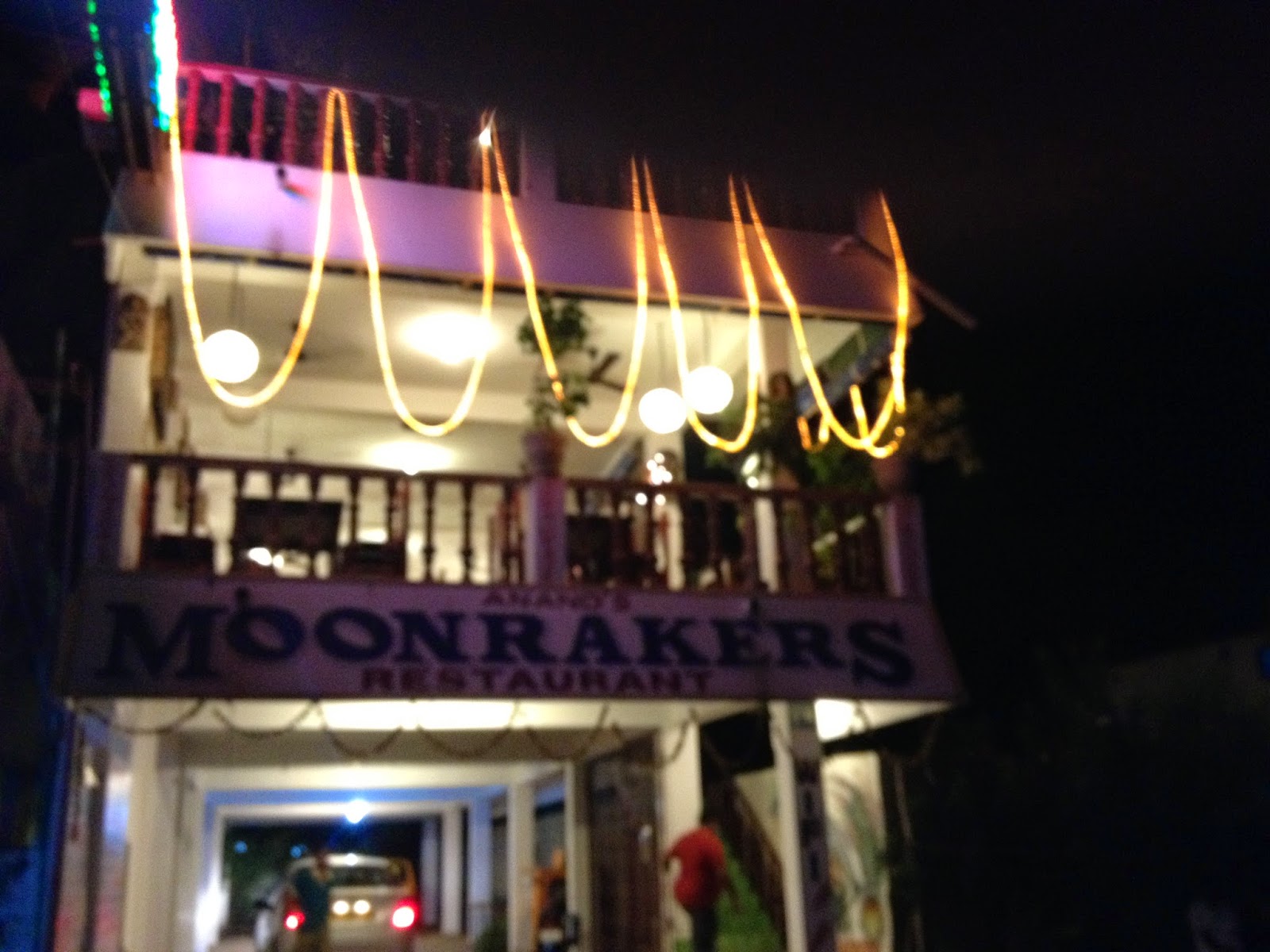
Then we went to Moonraker's 3 for Calamari with Madras Masala - OMG!!! And Tiger Prawn -- otherwise known as The Biggest Freakin' Shrimp I've Seen in My Life!
(If you go to Moonrakers, make sure you sit on the roof, where you can listen to the ocean waves and the crackle of the wind through the palm fronds while you eat. Maybe a stray raindrop or ten will fall while you're out there. Or there might even be fireworks.)
Then we went to Moonraker's 3 for Calamari with Madras Masala - OMG!!! And Tiger Prawn -- otherwise known as The Biggest Freakin' Shrimp I've Seen in My Life!
(If you go to Moonrakers, make sure you sit on the roof, where you can listen to the ocean waves and the crackle of the wind through the palm fronds while you eat. Maybe a stray raindrop or ten will fall while you're out there. Or there might even be fireworks.)

| 
|

|

|

|

|

|
|
Tuesday, July 1, 2014
Mahabalipuram (Part 3)
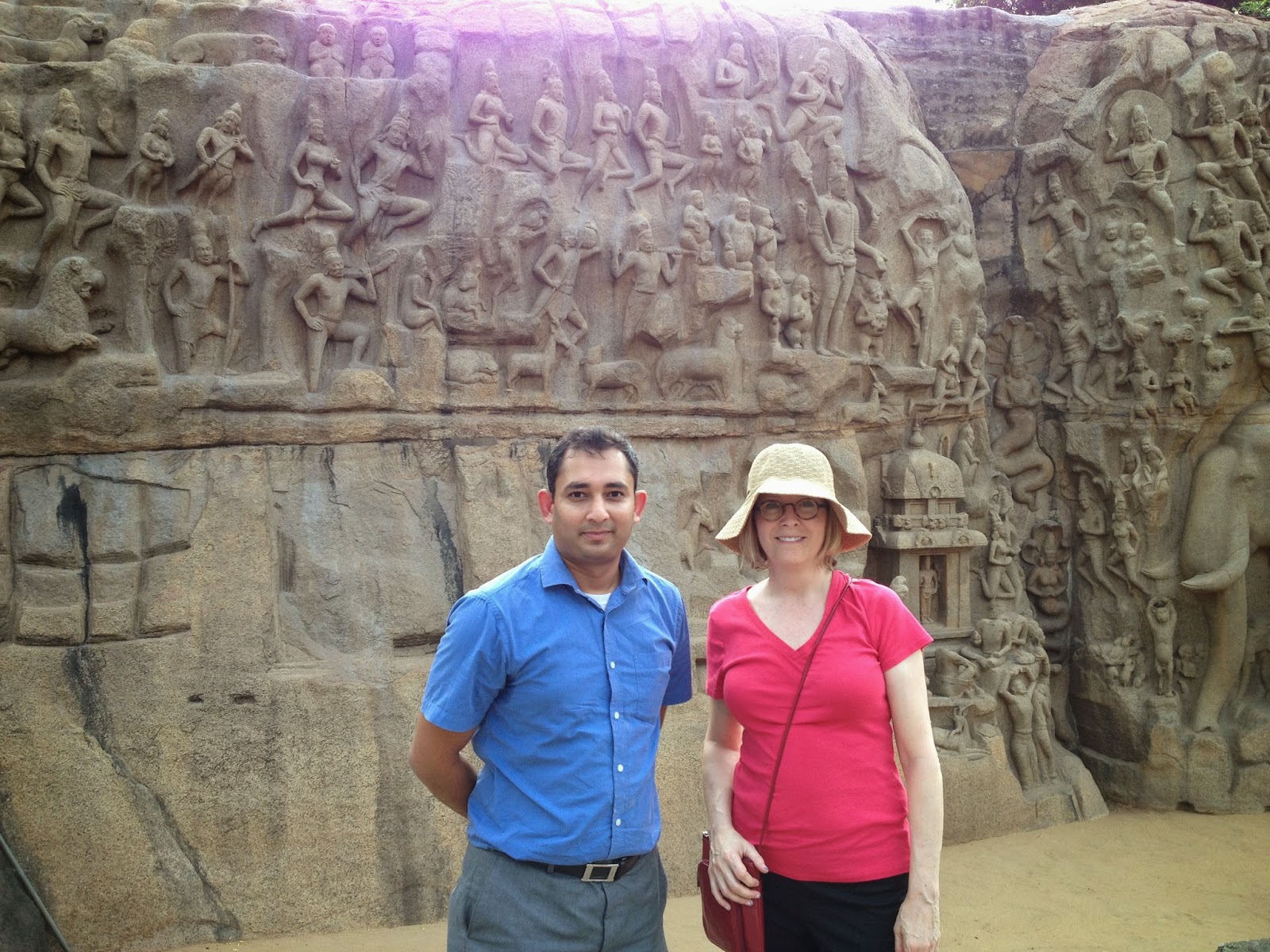
We employed our new Aussie friends to help us with the camera, when our over-40 fingers mucked up the works.
This giant rock has balanced for centuries on a hill, with contact to the ground on only the barest amount of surface area.
And, I had my first tender coconut water.

|

|

|

|

|

|

|

|





Mahabalipuram (Part 1)
After a few hours to catch up on email, and do some socializing with the team, Raja, Saj and I headed out with my driver, whose name is actually Saravanan (no idea why it was texted to me as Palani originally), to Mahabalipuram.
On the drive there we passed de-salinization plants which are turning sea water into drinkable water for the city of Chennai. Saj said his house is getting the new water, and he notices no difference -- except that all of his pet fish keep dying.
I realized once again that Raja has such a depth of knowledge, that he can hold forth for hours on any topic you throw him… whether it be de-salinization, Gandhi's salt boycott, cricket, mango farming, or the monkeys crossing the road in front of our car!
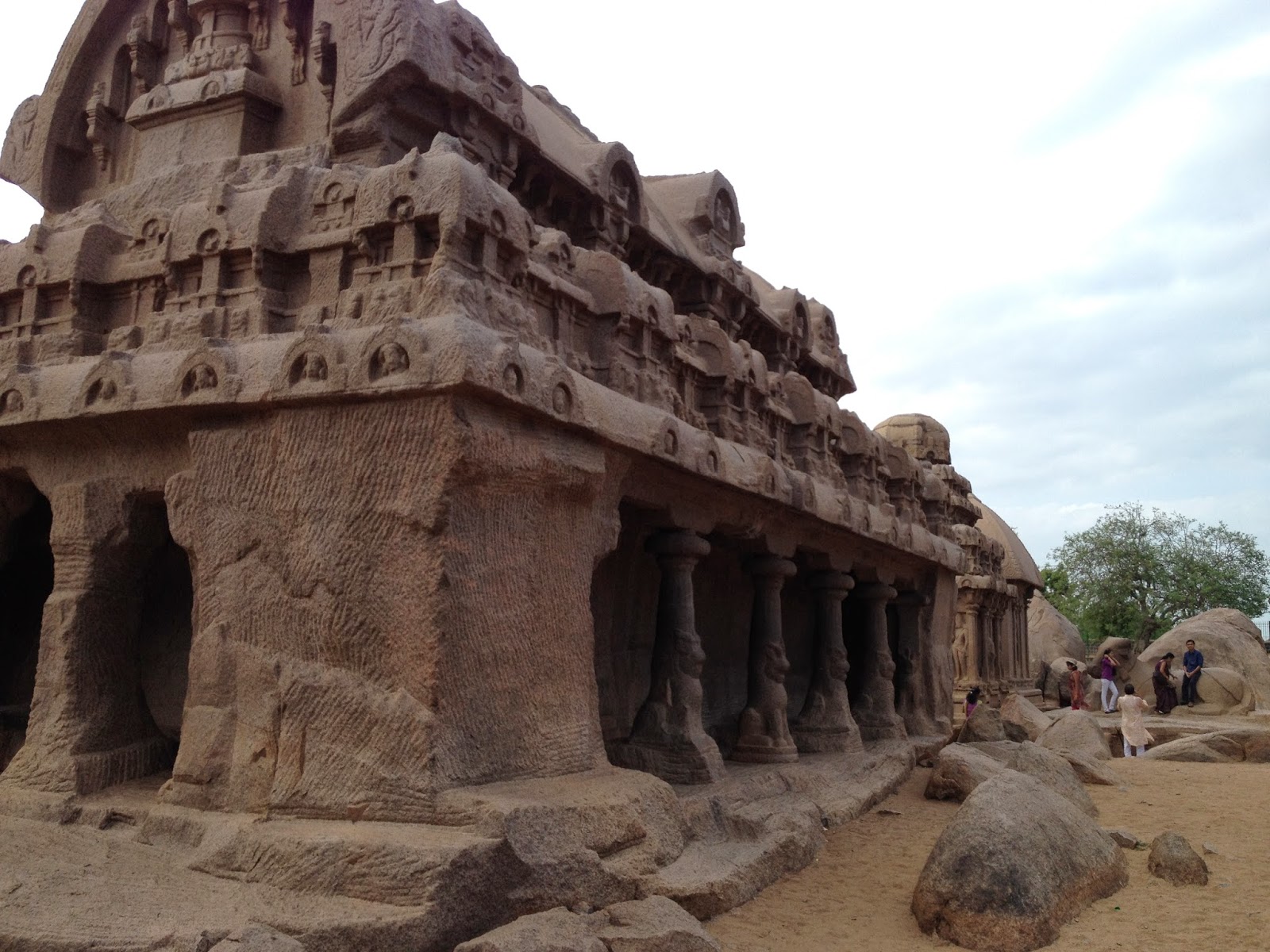
In Mahabalipuram are a group of temples which were carved top down into a single monolithic stone.
(Interesting tidbit: Raja and Saj's tickets were 10 rupees each; mine was 250 rupees. WTF! While the actual dollar cost is nominal, I cannot imagine European visitors coming to the US, visiting Yosemite or Arches, and agreeing to pay 25 times the US citizen cost to enter.)
Raja fell in love with my iPhone, so we have lots of good shots from our trip there. These posts show only a few.
On the drive there we passed de-salinization plants which are turning sea water into drinkable water for the city of Chennai. Saj said his house is getting the new water, and he notices no difference -- except that all of his pet fish keep dying.
I realized once again that Raja has such a depth of knowledge, that he can hold forth for hours on any topic you throw him… whether it be de-salinization, Gandhi's salt boycott, cricket, mango farming, or the monkeys crossing the road in front of our car!
In Mahabalipuram are a group of temples which were carved top down into a single monolithic stone.
(Interesting tidbit: Raja and Saj's tickets were 10 rupees each; mine was 250 rupees. WTF! While the actual dollar cost is nominal, I cannot imagine European visitors coming to the US, visiting Yosemite or Arches, and agreeing to pay 25 times the US citizen cost to enter.)
Raja fell in love with my iPhone, so we have lots of good shots from our trip there. These posts show only a few.

|

|

|

|

|

|

| 
|
Monday, June 30, 2014
Gates
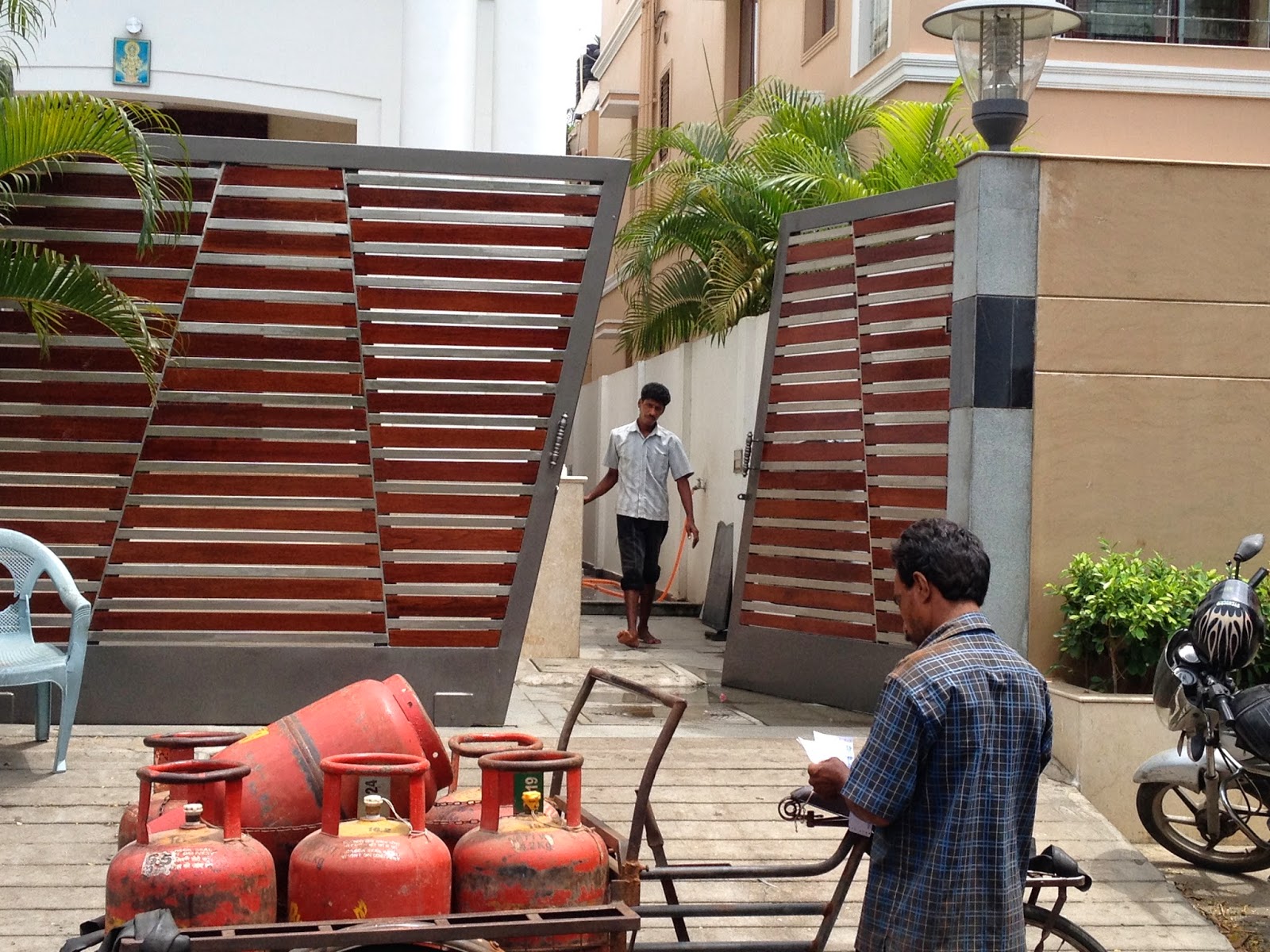
The next day on the way to the office, my driver stopped so I could take photos of the beautiful gates in the walls of the huge houses near my hotel, on Adyar Gate Club Road and Archbishop Mathias Road.

|

|

|

|

|
|

|

|
At the Sports Bar
We meet up with Raja in a sports bar, where TVs were showing the World Cup, and where I was the only female present, for the entire evening. Not even a female server. Just another scenario in India where I am the only one of my category. :-)
It was not the typical American sports bar experience. Instead of there being loads of fans sitting together and cheering plays under giant screens and neon beer signs, this place had an Irish pub feel -- very dark lighting with heavy wood furniture and small TVs.
We had excellent food while we were not watching the World Cub. We had little finger snacks, like you would get in a US bar -- and Saj and Raja reminisced about the roasted peanuts in US bars, where you throw the shells onto the floor.
We had shrimp in Madras Masala -- I think that is what it was called -- which was so spicy and so fabulous! (Note to self - bring Madras Masala combination back to my own kitchen!!)
AND. We had boiled peanuts!!!! OMG, I thought only folks in the Southern US ate boiled peanuts!! They were so good! Though very interesting that they were served already shelled. Usually half the fun in eating them is cracking the shells and sometimes sucking out the salty water. Mmm mmm mmm!
And of course, cold beer. Because, what is an evening with Raja, without cold beer?!
It was not the typical American sports bar experience. Instead of there being loads of fans sitting together and cheering plays under giant screens and neon beer signs, this place had an Irish pub feel -- very dark lighting with heavy wood furniture and small TVs.
We had excellent food while we were not watching the World Cub. We had little finger snacks, like you would get in a US bar -- and Saj and Raja reminisced about the roasted peanuts in US bars, where you throw the shells onto the floor.
We had shrimp in Madras Masala -- I think that is what it was called -- which was so spicy and so fabulous! (Note to self - bring Madras Masala combination back to my own kitchen!!)
AND. We had boiled peanuts!!!! OMG, I thought only folks in the Southern US ate boiled peanuts!! They were so good! Though very interesting that they were served already shelled. Usually half the fun in eating them is cracking the shells and sometimes sucking out the salty water. Mmm mmm mmm!
And of course, cold beer. Because, what is an evening with Raja, without cold beer?!
Heading for home at 10pm
In the short ride to the sports bar where we were meeting Raja, Saj and I talked about his life since returning to India, and about the working lives of my offshore teammates.
Saj had lived in Charlotte for a while and worked on our system as a contractor. When Raja went back to India to set up the offshore team, he reached into the contractor firms and poached a number of the most knowledgeable resources as the foundation for his team.
Everyone came to employment for Raja with the knowledge that they would come to work at midday Chennai time, and then stay through about half of the US workday -- so they expect to leave for home at 9-10pm. M-F. This sounded OK on paper, and while everyone was still young. Yet as the realities creep in, it becomes taxing.
For example, most of our offshore team isn't assigned laptops as our US team is -- they work on desktops. So when working on a problem or when interfacing directly with a US teammate, though they have wifi at home for their personal electronics, they have to remain in the office.
Another thing -- more alarming to me, as I would never have thought of this issue-- is that the docile dogs I've seen trotting around or napping in the shade during the daytime, gang up into packs at night and run through the streets. This poses dangerous situations for our guys (and girls) who ride scooters and motorcycles (and especially bicycles!) to work. Imagine the terror of riding your scooter home, through dark streets, at 10pm, after a tiring day, only to be chased by a pack of feral dogs.
Another issue with traveling through the streets so late at night -- as I've mentioned before in this blog -- is the danger of attack women in India face daily. I shudder to think of Mena -- a mother with a newborn -- riding through dark streets at night.
Saj had lived in Charlotte for a while and worked on our system as a contractor. When Raja went back to India to set up the offshore team, he reached into the contractor firms and poached a number of the most knowledgeable resources as the foundation for his team.
Everyone came to employment for Raja with the knowledge that they would come to work at midday Chennai time, and then stay through about half of the US workday -- so they expect to leave for home at 9-10pm. M-F. This sounded OK on paper, and while everyone was still young. Yet as the realities creep in, it becomes taxing.
For example, most of our offshore team isn't assigned laptops as our US team is -- they work on desktops. So when working on a problem or when interfacing directly with a US teammate, though they have wifi at home for their personal electronics, they have to remain in the office.
Another thing -- more alarming to me, as I would never have thought of this issue-- is that the docile dogs I've seen trotting around or napping in the shade during the daytime, gang up into packs at night and run through the streets. This poses dangerous situations for our guys (and girls) who ride scooters and motorcycles (and especially bicycles!) to work. Imagine the terror of riding your scooter home, through dark streets, at 10pm, after a tiring day, only to be chased by a pack of feral dogs.
Another issue with traveling through the streets so late at night -- as I've mentioned before in this blog -- is the danger of attack women in India face daily. I shudder to think of Mena -- a mother with a newborn -- riding through dark streets at night.
SanThom
Our next stop was St Thomas Basilica, or SanThom as everyone calls it. Legend has it this Roman Catholic church was built upon the burial spot of Saint Thomas, who was one of the twelve disciples of Jesus Christ. Various tales surround his death near Chennai - whether he was an old man caring for a flock of early Christians who died a peaceful death, or a still enthusiastic evangelist who had drawn the ire of local holy men, who is to say.
We walked through the spitting rain to a building in the back of the main church, removed our shoes, and descended a staircase to an antechamber, where a stern nun cautioned us to keep silent (the threat of ear pulling unstated, but known nonetheless -- and really, what visit to a Catholic church is complete without a nun cautioning one to be quiet?).
Then we entered the burial chamber, a small chapel with a center row and pews on either side. At the top of the room was a clear box containing a reclining bearding mannequin suggesting St Thomas in death. The box was stood directly on dirt exposed through a rectangular hole cut in the stone floor, further urging the belief of the basilica being built directly on the site of the saint's final resting place. A section of human bone, framed in a shadowbox and purported to belong to the saint resting below, hung on a column to the right of the mannequin.
We sat in a pew for a few moments in silent reflection (neither Saj nor myself wanting to experience the Ear Treatment), and then headed out.
We walked through the main cathedral, which had been rebuilt in the 19th century in a British-preferred style, but was decorated in an unmistakably Indian fashion with flowers and bright colors. A female pastor was leading an evening service, reminding me of the evangelical services I've had the unexpected misfortune to attend, with folks in the congregation calling out to the pastor. We sat and observed. It was loud and earthy -- folks quickly going up the center aisle and to the right, to pray before a saint.
As we exited into the drizzle, Saj explained that this particular group of Catholic churches were somewhat more expressive than the RC church he had grown up in and still attends.
We walked through the spitting rain to a building in the back of the main church, removed our shoes, and descended a staircase to an antechamber, where a stern nun cautioned us to keep silent (the threat of ear pulling unstated, but known nonetheless -- and really, what visit to a Catholic church is complete without a nun cautioning one to be quiet?).
Then we entered the burial chamber, a small chapel with a center row and pews on either side. At the top of the room was a clear box containing a reclining bearding mannequin suggesting St Thomas in death. The box was stood directly on dirt exposed through a rectangular hole cut in the stone floor, further urging the belief of the basilica being built directly on the site of the saint's final resting place. A section of human bone, framed in a shadowbox and purported to belong to the saint resting below, hung on a column to the right of the mannequin.
We sat in a pew for a few moments in silent reflection (neither Saj nor myself wanting to experience the Ear Treatment), and then headed out.
We walked through the main cathedral, which had been rebuilt in the 19th century in a British-preferred style, but was decorated in an unmistakably Indian fashion with flowers and bright colors. A female pastor was leading an evening service, reminding me of the evangelical services I've had the unexpected misfortune to attend, with folks in the congregation calling out to the pastor. We sat and observed. It was loud and earthy -- folks quickly going up the center aisle and to the right, to pray before a saint.
As we exited into the drizzle, Saj explained that this particular group of Catholic churches were somewhat more expressive than the RC church he had grown up in and still attends.
Friday, June 27, 2014
Where are the Sunsets?
It occurs to me that I haven't experienced an actual sunset while in India.
It seems that most days the sky begins to cloud up after 4pm. And then the light just fades away into night. And much much earlier than we are having in Charlotte during this time of year. This week in Charlotte we could expect to have daylight until 8:30pm plus. But here it's dark by 6:30.
Additionally, there is only one timezone for the whole of India, so being on the East Coast in Chennai now it feels as if it becomes darker earlier than it did in Hyderabad.
It seems that most days the sky begins to cloud up after 4pm. And then the light just fades away into night. And much much earlier than we are having in Charlotte during this time of year. This week in Charlotte we could expect to have daylight until 8:30pm plus. But here it's dark by 6:30.
Additionally, there is only one timezone for the whole of India, so being on the East Coast in Chennai now it feels as if it becomes darker earlier than it did in Hyderabad.
Look for the Essence
Going south, on the left side of the road was a wide beach. The widest expanse of beach I've ever seen. There were none of the dunes I expected, and so the ground was flat from the road leading right to the strand.
Dotted along as we drove were little shops for tourists -- cool drink shops, hot snack shops, water toy shops, and the like. These little wooden structures were sitting right on the sand, and it being a Tuesday evening most were closed until the weekend. People strolled along. Some folks rode horses. Fisherman's boats were pulled up onto the sand.
After a short ways I began to see on the sand next to the road a few folks sitting on reed maps or tarps, with their catch for the day spread out in front of them, making their livelihood, shooing away the flies which buzzed around the fish and shrimp and crabs. In just a matter of a few more feet along the road, the fisherman were sitting on their mats in front of tiny, fragile huts made from bamboo and reeds and driftwood, which served as their homes -- built on the sand next to the road. I caught glimpses into some of the houses, where people laid on the ground on sandy blankets, or sat looking out into the distance.
The ladies doing the selling were thin, wizened beyond their years, and the children were half dressed and smiling.
On the right side of the road, away from the beach, was row after row of tiny, old structures which served as home for a good many people milling about in the lanes. Every so often there were water faucets sticking up out of the ground which served the population. Temples and churches took prime real estate looking toward the waters where the people made their living.
Trash was everywhere, papers and bags and bottles and organic materials, large and small, blowing in the breeze or piled up against the sides of buildings or heaped up on corners.
"These are some of the happiest people in the world, " Saj said.
After the tsunami the government built new houses for all the people who lived in that area, so close to the water. But they refused to live in the new houses. They needed to be near the sea. So they came back to the beach, and those who had lost houses built new ones as best they could, to live next to the bay which gives them life.
Dotted along as we drove were little shops for tourists -- cool drink shops, hot snack shops, water toy shops, and the like. These little wooden structures were sitting right on the sand, and it being a Tuesday evening most were closed until the weekend. People strolled along. Some folks rode horses. Fisherman's boats were pulled up onto the sand.
After a short ways I began to see on the sand next to the road a few folks sitting on reed maps or tarps, with their catch for the day spread out in front of them, making their livelihood, shooing away the flies which buzzed around the fish and shrimp and crabs. In just a matter of a few more feet along the road, the fisherman were sitting on their mats in front of tiny, fragile huts made from bamboo and reeds and driftwood, which served as their homes -- built on the sand next to the road. I caught glimpses into some of the houses, where people laid on the ground on sandy blankets, or sat looking out into the distance.
The ladies doing the selling were thin, wizened beyond their years, and the children were half dressed and smiling.
On the right side of the road, away from the beach, was row after row of tiny, old structures which served as home for a good many people milling about in the lanes. Every so often there were water faucets sticking up out of the ground which served the population. Temples and churches took prime real estate looking toward the waters where the people made their living.
Trash was everywhere, papers and bags and bottles and organic materials, large and small, blowing in the breeze or piled up against the sides of buildings or heaped up on corners.
"These are some of the happiest people in the world, " Saj said.
After the tsunami the government built new houses for all the people who lived in that area, so close to the water. But they refused to live in the new houses. They needed to be near the sea. So they came back to the beach, and those who had lost houses built new ones as best they could, to live next to the bay which gives them life.
Subscribe to:
Posts (Atom)